How items are identified
Part numbers, not SKUs
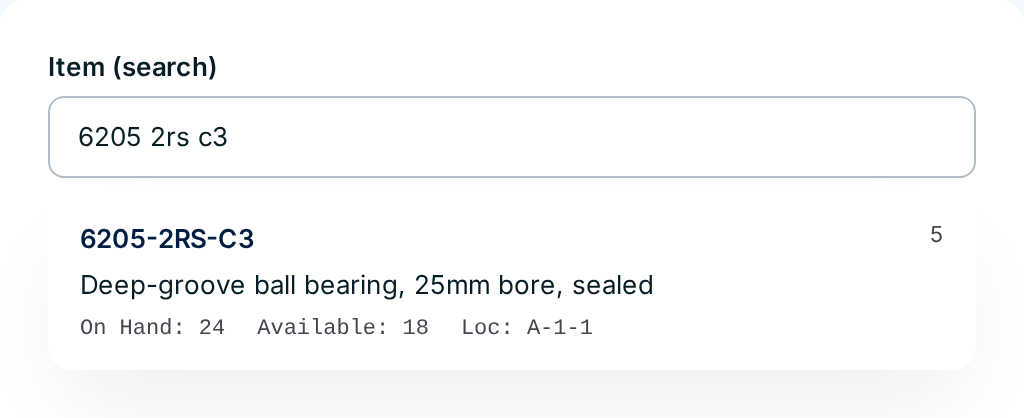
An item is known by the supply partner's part number. ConsignTrak doesn't invent its own code for it. The trouble is that the same part number gets written many ways: on a spreadsheet, a packing slip, a customer's order, a box label.
| Written as | Same item? |
|---|---|
| 6205-2RS-C3 | Yes |
| 6205 2RS C3 | Yes |
| 62052rsc3 | Yes |
| 6205.2RS/C3 | Yes |
ConsignTrak ignores dashes, spaces, dots, slashes, underscores and quote marks, and it ignores upper and lower case. All four lines above find the same bearing, with no guessing involved.
Other numbers for the same item
An item can also carry aliases: other numbers it's known by. These include a customer's own part number, an older number the supply partner replaced, or a cross-reference from another brand. Searching by any alias finds the item. Aliases show on the item's page under Alternate Numbers / Cross-References.
Today an administrator adds aliases through a bulk import. When a supply partner replaces a part, the office can discontinue the old item and name the one that supersedes it. Searches for the old number then lead to the new one.
When it's only a close match
If what you typed isn't the same part number, even ignoring punctuation, ConsignTrak looks for close matches. A close match shows a percentage next to it. The higher the number, the closer the match.
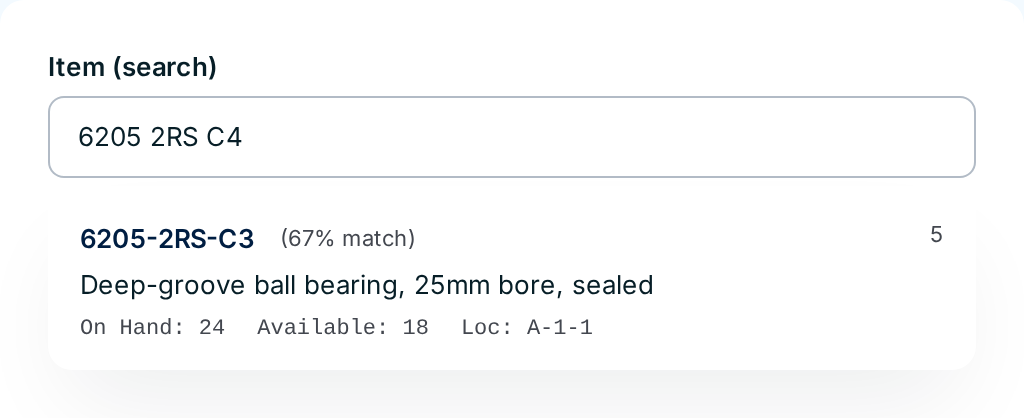
A close match is only a suggestion. Nothing is chosen until you choose it. Before you accept one, check that:
- the supply partner is right (the number on the right is the manufacturer code),
- the description matches what's on the paperwork or in your hand, and
- the difference is a typo, not a real difference. A C3 and a C4 bearing are different parts.
A wrong match ships or counts the wrong item. If none of the results is clearly right, stop and check the part number with the office or the supply partner.
The same idea appears in other places with slightly different labels:
| Where | How a close match is shown |
|---|---|
| Item search boxes (orders, adjustments, receiving) | (NN% match) next to the part number |
| Spreadsheet import review | An amber Fuzzy (NN%) badge on the row |
| Inventory check | A Fuzzy or Fuzzy match badge |
What gets printed
Orders, releases and history keep the part number as it looked when the work was done. If the item is renamed later, older paperwork still reads the way it did.
Where you'll see this
- Orders: adding a line searches only that order's supply partner.
- Receiving: the import review marks close matches in amber.
- Inventory & items: the item page and its aliases.
- Looking things up on the phone.